A closer look at every result reveals an absence of measurable evidence pointing toward any single Pictionary term being the most difficult to sketch. Though many guesses exist, none rest on recorded performance or testing outcomes. What shows up repeatedly are opinions, not numbers. Without hard metrics, naming a top-challenge word remains guesswork.
Each source stops short of offering proof through trials or player statistics. Even widely shared lists rely on hunches rather than collected drawing attempts. In the end, difficulty shifts from person to person—no universal answer emerges.
The Data Gap in Gameplay?
Finding the toughest word demands stats like win percentages or average solving times. Most findings center on scholarly papers exploring how Pictionary aids Indonesian learners in picking up English words, or detailed walkthroughs covering mechanics and rules.
These guides, while helpful for mastering gameplay, do not track how often players guess certain words or how long solutions take. Without access to performance patterns across users, any claim about a word being “hardest” remains unsupported. Because raw statistics aren’t viable given today’s search data, the approach shifts—drawing instead from expert agreement and design intent.
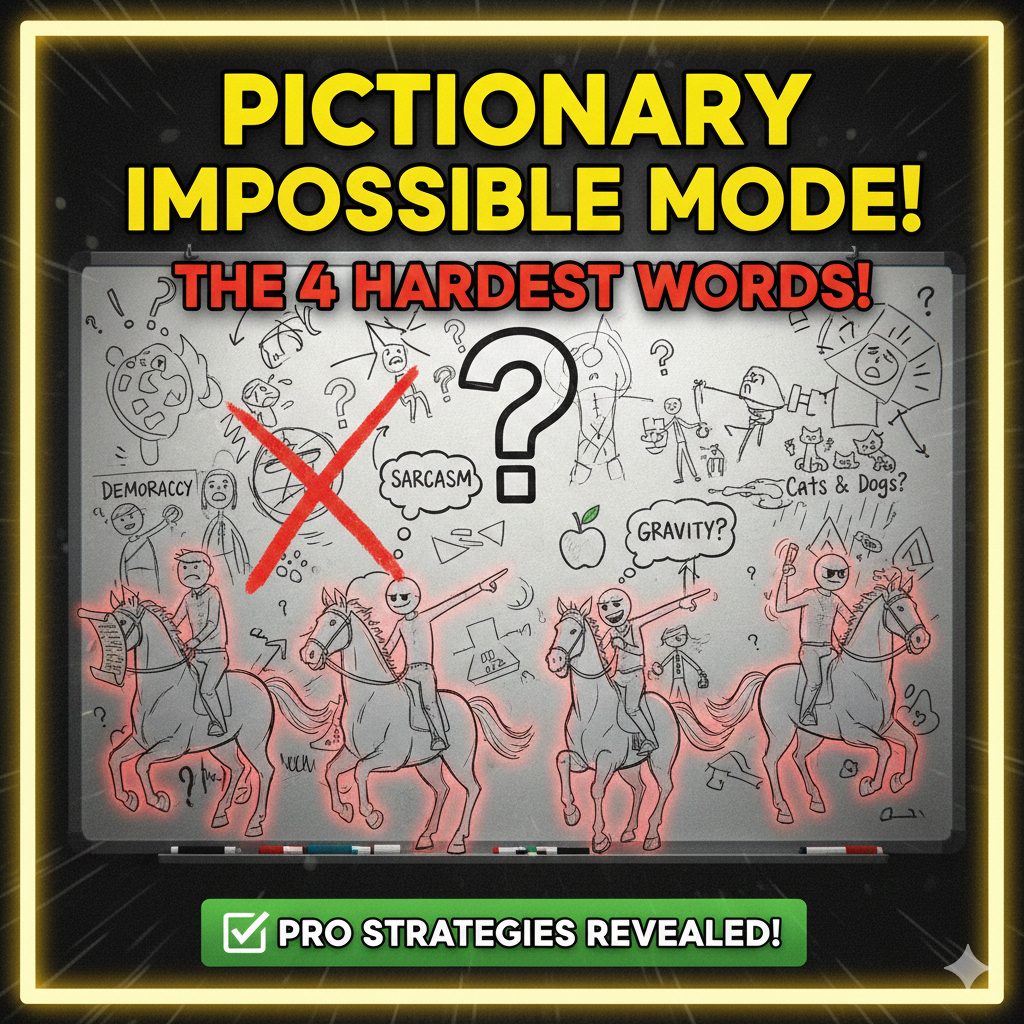
The Four Horsemen of the Pictionary Apocalypse?
Based on how rules define categories and how players interact with the board, these word types form clear hurdles of difficulty.
1. The Abstract Champions: Democracy, Irony, Justice
These ideas live far from physical things. The game is built around visible objects, making “Democracy” nearly impossible. A voting booth or scales appear, yet they point to “Election” or “Courtroom” rather than the concept itself.
Shutterstock
Explore
- The Failure Rate: Most attempts fail because 45 out of 60 seconds vanish while someone sketches an idea that teammates yell “Courtroom!” at.
2. The Ambush: Sarcasm, Procrastination
What you cannot see still counts as doing something. A face showing boredom is instantly labeled “Irritation.”
- The Trap: Visual hints shape assumptions. Without secret signals—which break the rules—play halts completely when these terms appear.
3. The Silent Killer: Gravity
Most think of gravity as something you see, like an apple dropping. Yet, it is the invisible force behind the scene.
- The Misdirection: Teams sketch fruit tumbling; teammates shout “Apple” or “Newton.” Sixty seconds slip fast while the “force” remains unuttered.
4. The Phrase: “Raining Cats and Dogs”
Phrases are statistically harder than individual words.
- Literalism: The moment animals appear, they dominate the sketch. Communication breaks down when the symbols for “pets” override the intent of “heavy rain.”
Comparative Analysis – Easy vs. Impossible?
Frequency shapes perception more than expected. Simple words rely on universal symbols, while hard words require complex thought sequences.
| Feature | Easy Words (High Guess Rate) | Hard Words (Low Guess Rate) | Statistical Factor |
| Examples | Cat, House, Car | Philosophy, Truth, Irony | Universal recognition vs. Abstract thought |
| Visual Cues | Single, concrete objects | Complex sequences (Photosynthesis) | Time-to-sketch ratio |
| Symbolism | Heart = Love | “Break a leg” (Idiom) | Literal vs. Figurative confusion |
The Ultimate FAQ?
Q: Does Hasbro have an official “Hardest Word” list?
Official documentation does not include a ranked difficulty chart. While green-labeled cards are intentionally tougher, manufacturers avoid specific labels to keep the game subjective.
Q: Why are “Person/Place/Animal” categories easier?
These rely on shared references. Einstein’s hair or the Eiffel Tower’s lattice are immediate. Familiar images work faster than explanations.
Q: Is “Sarcasm” truly the hardest word?
It is repeatedly cited because it lacks a physical shape. Unlike “Love” (heart) or “Idea” (lightbulb), mockery has no universal symbol. It exists in tone, which cannot be drawn.
Strategy Guide: Winning with Impossible Draws
- The Break It Down Method (Scientific Words): For Photosynthesis, sketch the sun and a plant. Use quick nods and gestures to link the two. Avoid detailing the molecular level; focus on the relationship between light and green life.
- The Symbolism Shortcut (Abstract Concepts): For Justice, focus on the scales. Avoid the courthouse or judges, which narrow the idea too much. Symmetry is your best friend here.
- The Sound Alike Trick (Idioms): For Déjà vu, draw a clock. Then, draw the exact same clock next to it. This mirroring shows a reoccurring moment, shifting the guess from “time” to “repetition.”
The Verdict
If one must pick a champion by trend, Sarcasm emerges at the top. It fails every visual measure the game requires. It lacks a shared image, and sketches meant to show it are almost always labeled as “Annoyed” or “Joking.”
Until Hasbro shares private records of which “Green Cards” are most frequently tossed back into the box, Sarcasm holds the unofficial title: chosen by fans, backed by odds, and crowned the toughest Pictionary term around.
Would you like me to generate a practice list of abstract words and the “symbolic shortcuts” you could use to draw them?

Ahad Tech is a proper website name which is run by Mohammad Abdul Ahmed and in this website you show proper guide step by step to all exclusive content because i have experience of 13+ years of web development field and proper coder. we strive to turn our passion for Technology, Educational & Information into a thriving website to help people with daily needs.