That sound when a customer clicks “Add to Cart”? Most online sellers love it. Yet overlooking returns skews the picture – what looks like gain may just be noise. Profit hides behind the refund requests, not in the initial sale.
Picture big sales numbers – now imagine profits shrinking anyway. That happens when returns eat away at revenue, quietly. A sky-high return rate makes regular gross margin look better than it really is. This moment shines a light on what hides behind those figures. Enter Return-Adjusted Gross Margin (RAGM), the number showing actual performance. It factors in losses from items coming back. Suddenly, results feel less rosy – but more real.
Understanding Return-Adjusted Gross Margin
What remains of your income, once production expenses and return-related losses are subtracted, reflects the Return-Adjusted Gross Margin. This figure expresses how much of each dollar earned stays within the business. It includes deductions not only for what it costs to make the product but also for items customers sent back.
Read Also : https://ahadtech.in/margin-calculator-tool-how-to-use-full-guide/
The result appears as a portion of total sales, adjusted downward by these combined factors. Instead of just measuring upfront profitability, it accounts for real-world setbacks like returns. A clearer picture emerges when both manufacturing outlays and customer reversals shape the outcome. Though basic Gross Margin shows profit on successful sales, RAGM reflects profitability even when items go unsold. What matters here isn’t just what sells – it’s how much value slips away when things do not.
The Scenario and Calculation
A calculation like this makes more sense when tied to an actual situation:
- Selling Price: 100 Dollars
- Cost of Goods Sold (COGS): Forty Dollars
- Standard Gross Margin: 60% (($100 – $40) / $100)
- Return Rate: 35 Percent
- Restocking Fee: A fee of five dollars applies when returning each product.
1. Calculate Return Costs
Every time someone sends back a product, not only does the expected gain vanish – so does part of what was already earned.
- Refund: A hundred dollars goes back to the customer.
- Restocking Fee: For every return, a five-dollar charge applies. The shopper receives less by that sum; the five dollars is retained by the seller.
- Inventory Recovery: Getting the item returned means recovering the $40 cost. The product reenters circulation as a usable asset.
Read Also : https://ahadtech.in/how-2026-epr-plastic-fees-impact-e-commerce-profits-uk-france-guide/
2. The Net Loss Per Return
From the transaction, $5 came in as a restocking fee. Out of that, $100 went back out. Overall, the movement left $95 exiting the account. Yet, with $40 of stock returned to your shelf, that missing $60 in earnings is a real hit to income.
3. Total Revenue Adjusted for Returns (Based on 100 Transactions)
- Gross Sales: 100 items at $100 = $10,000
- Refunds Issued: 35 items at $100 = $3,500
- Restocking Fees Collected: 35 items at $5 = $175
- Net Sales Revenue: $10,000 – $3,500 + $175 = $6,675
4. Calculate COGS
- Units Shipped: 100 units at $40 = $4,000(Note: COGS reflects items sent out, not revenue after returns).
5. Calculate Return-Adjusted Gross Profit and Margin
- Return-Adjusted Gross Profit: $6,675 (Net Revenue) – $4,000 (Total COGS) = $2,675
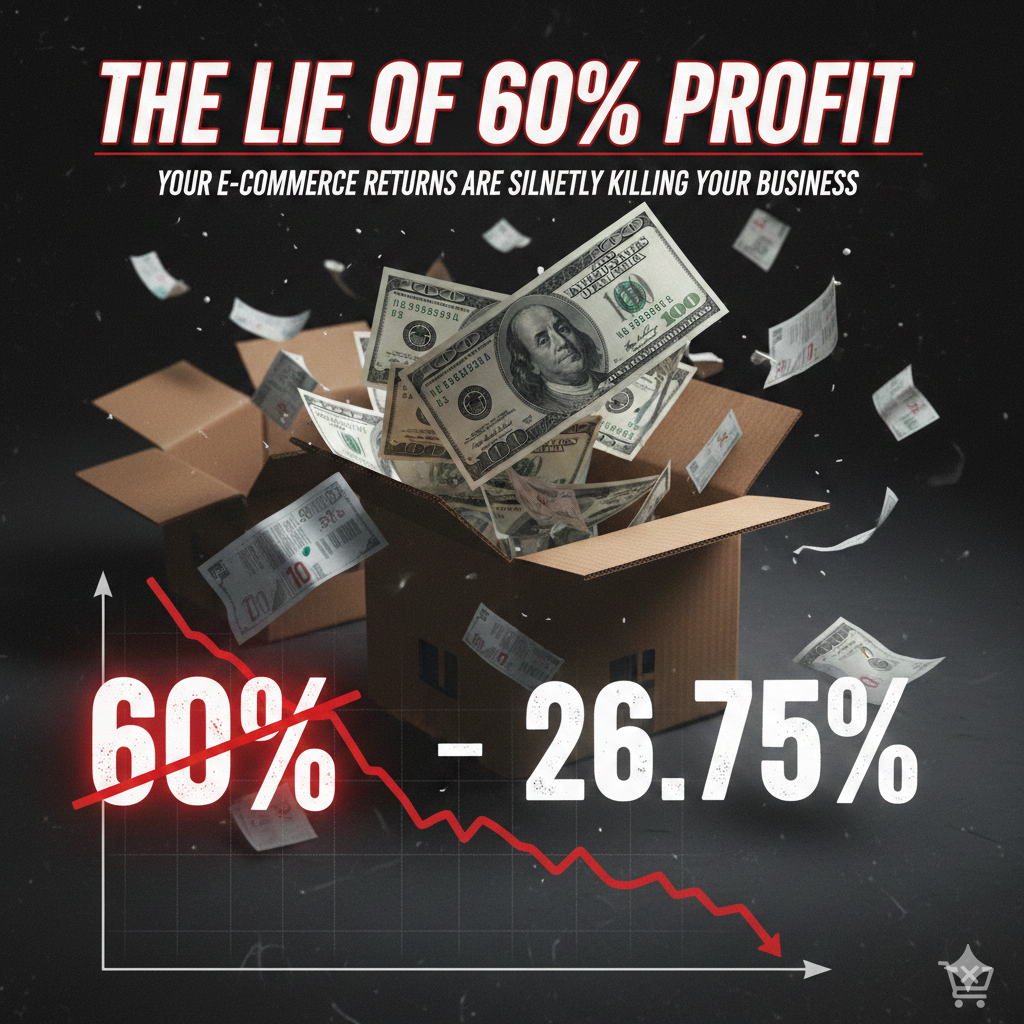
- Return-Adjusted Gross Margin: $2,675 / $10,000 (Gross Sales) = 26.75%
The Reality: That 60% gross margin looks strong at first glance. Yet once returns hitting 35% enter the picture, profitability drops hard, landing at just 26.75%.
Better Decisions From Watching One Number
- True Marketing Budget: Growth fails when hidden costs drain resources. What looks like a 60% budget for advertising shrinks closer to 27% once expenses are clear.
- Sourcing Choices: Whether a product type sees many returns affects how sourcing choices are made. When return rates climb, the appeal of certain products may drop despite strong initial sales.
- Fee Validation: Does that restocking charge actually match the cost? A sum like five dollars likely falls short when handling expenses (shipping, checking, repackaging) add up.
- Inventory Planning: Knowing your RAGM clarifies the amount of cash required to cover inventory restocking, sharpening predictions about future financial needs.
Advantages and Drawbacks of RAGM Use
| Pros | Cons |
| Comprehensive View: Links campaign conversion with return frequency. | Complexity: Demands effort to track individual units rather than totals. |
| Precise CAC Analysis: Helps avoid overspending in marketing by showing real acquisition costs. | Time Lags: A gap of 30-60 days between sale and return blurs short-term views. |
| Product Insight: Low RAGM reveals flaws in design, fit, materials, or photo accuracy. | Hidden Expenses: Often misses extra costs like return postage or staff labor. |
Frequently Asked Questions
Q: How This Differs From Net Profit Margin?
RAGM focuses strictly on how returns and production costs affect initial income. Net Profit Margin accounts for every cost, such as advertising, wages, and server fees. RAGM is an intermediate step.
Q: Does the restocking fee actually help?
Yes. In this scenario, without the $5 charge, RAGM would drop to 25%. The fee preserved 1.75 percentage points in margin.
Q: My return rate is 35%. Is that bad?
In apparel, 35% is common. In electronics or home goods, 35% is dangerously high. Sustainability depends on whether your pricing holds up under the RAGM calculation.
Ways to Boost Return-Adjusted Gross Margin?
- Lower the Return Rate: Improve size charts, use product clips showing real use, and check items before they ship.
- Adjust Fees: A higher restock charge may apply, if permitted, to help offset handling expenses.
- Improve Unit Economics: A price hike or lower production costs can help. A bigger margin cushions the impact of returns.
Conclusion
A store selling online might think it keeps sixty cents from every dollar earned—until returns eat through that profit. Figuring out the Return-Adjusted Gross Margin shows your actual profit sits near 26.75%. Forget tracking every sale you close. Begin watching how many customers stay.

Ahad Tech is a proper website name which is run by Mohammad Abdul Ahmed and in this website you show proper guide step by step to all exclusive content because i have experience of 13+ years of web development field and proper coder. we strive to turn our passion for Technology, Educational & Information into a thriving website to help people with daily needs.