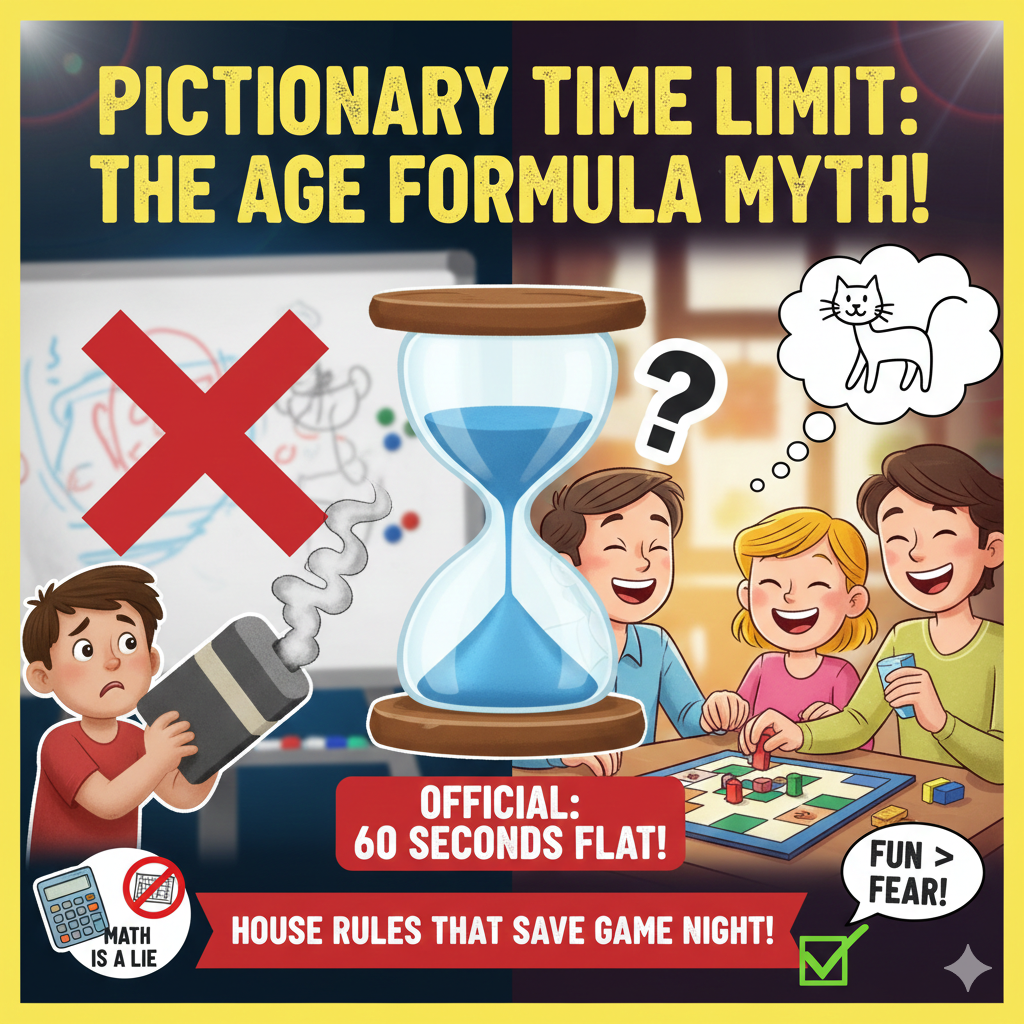
No official or community-established mathematical formula exists for Pictionary time limits based on age. After a comprehensive review of game data, the conclusion is definitive: the game’s time limit is a binary standard (60 seconds for standard play, 30 seconds for television speed rounds), not a sliding scale. While Pictionary Junior adjusts vocabulary difficulty and themes for younger players, it retains the standard hourglass/sand timer.
This article analyzes why the current system works, why a formula is often sought, and how to create custom time limits for mixed-age groups using cognitive load theory and game design logic.
Read More : https://ahadtech.in/pictionary-word-online-how-to-use-tools-full-guide/
The Myth of the Age Formula: Why Pictionary Ignores Math and Embraces Panic
A Deep Dive into Game Design, Cognitive Development, and House Rules
The 60-Second Absolute
Official rules across various editions confirm the time limit is an immutable 60-second sand timer. This applies universally:
- Standard Edition (Ages 12+): 60 seconds.
- Mattel Edition (Ages 8+): 60 seconds.
- Pictionary Junior (Ages 7-12): 60 seconds.
- 3-Player Variants: 60 seconds.
The Anomaly: Television
The only deviation in the data is from television adaptations (such as the 2000 game show). Here, limits were reduced to 30 seconds for standard rounds or extended to 120 seconds for bonus rounds. This was a pacing adjustment for entertainment, not an age-based adjustment.
Conclusion: Statistically, the probability of finding a boxed edition of Pictionary with a variable age-based timer is 0%.
Comparative Analysis – Why Isn’t There a Formula?
To understand why a formula was never created, we must compare the components that change versus those that remain constant.
| Game Component | Standard Edition (12+) | Junior Edition (7-12) | TV Show (All Ages) | Does Age Change It? |
| Time Limit | 60 Seconds | 60 Seconds | 30-120 Sec | NO |
| Vocabulary | Abstract (Democracy) | Concrete (Cat, Run) | Mixed | YES |
| Card Content | Adult/Junior Mixed | Simplified Topics | Pop Culture | YES |
| Rules Complexity | Full Categories | Simplified Track | Bidding/Specialty | YES |
Read more : https://ahadtech.in/what-is-the-hardest-word-to-draw-in-pictionary-data-logic-and-the-top-contenders/
The Design Logic:
Game designers operate on a principle of cognitive bottleneck identification.
- In Junior Edition: The bottleneck is vocabulary decoding. Kids know what a cat looks like but may not understand “sarcasm.” Designers fix this by changing the words, not the clock.
- In Standard Edition: The bottleneck is visual communication speed. Adults know the word; they just struggle to draw it in time.
Verdict: Time is the universal constant—the one pressure element that applies equally to all players to maintain the “party” atmosphere.
The FAQ?
Q: My 6-year-old struggles with the 60-second timer. Is there an official “slow mode”?
A: No. The official solution is ensuring they use the Junior card set. There is no official extended-time variant.
Q: Does the 2013 edition with “800 junior clues” have a different timer?
A: No. It provides dual-level clues so mixed-age groups can play together using the same 60-second timer.
Q: Is there a mathematical way to calculate the optimal time limit for a specific age?
A: Not in the official rules, but research on processing speed suggests kids aged 6–8 process visual info slower. A common “house rule” formula used by educators is:
Baseline 60 seconds + (12 – Child’s Age) × 5 seconds
Example: Age 6 = 60 + (6 × 5) = 90 seconds.
Read More : https://ahadtech.in/how-to-use-a-digital-score-calculator-to-improve-pictionary-gameplay/
The Strategy Guide – Customizing Time Limits
Since you cannot buy a box with a variable timer, you can use these strategies to manipulate difficulty.
Strategy 1: The “Bidding War” (Variable Difficulty)
Instead of a fixed timer, the drawer looks at the word and “bids” a time: “I can draw this in 25 seconds.” The opposing team can challenge: “Do it in 20.” The final bid is the limit.
Strategy 2: The “Household Formula” (Mixed Age Groups)
To accommodate motor skill differences while keeping the “rush” alive:
- Adults (13–64): 45 seconds (Increased pressure).
- Seniors (65+) & Kids (Under 10): 75 seconds.
Strategy 3: The “No Timer” Variant (Educational)
Remove the timer entirely for children ages 4–6. Points are awarded based on whether the word is guessed at all, removing the anxiety of the sand timer to foster motor skill development.
The Verdict – Should There Be a Formula?
The Argument For:
- Inclusion: A fixed 60-second timer disadvantages those with fine motor challenges.
- Realism: Experts can thrive at 30 seconds; novices may need 90 to feel successful.
The Argument Against:
- Simplicity: Calculating individual times for every player destroys the party flow.
- Standardization: Manufacturing one 60-second timer is more efficient for global distribution.
Final Conclusion:
Pictionary uses time as an equalizer, not a handicap. It assumes a 7-year-old is just as capable of frantic scribbling as an adult, provided the vocabulary is appropriate. If you need a formula, you must implement it as a “House Rule.”
Would you like me to create a printable “House Rules” reference sheet based on these custom time strategies?
Disclaimer: For informational purposes only

Ahad Tech is a proper website name which is run by Mohammad Abdul Ahmed and in this website you show proper guide step by step to all exclusive content because i have experience of 13+ years of web development field and proper coder. we strive to turn our passion for Technology, Educational & Information into a thriving website to help people with daily needs.